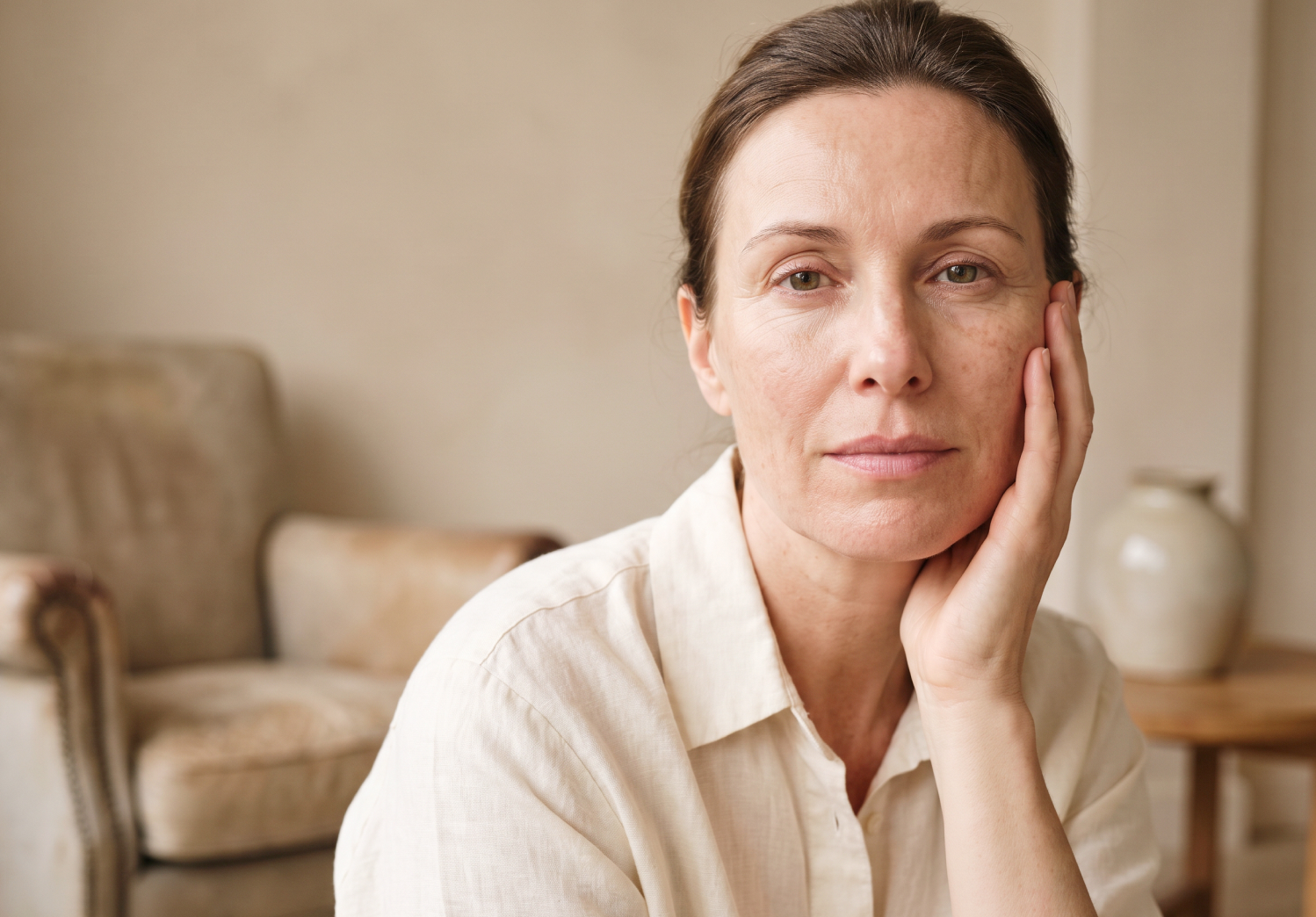
There comes a point for most women when the skin starts doing something unfamiliar. Products that worked for years suddenly don’t. Dryness appears where it never was before. Breakouts return for no apparent reason. The texture changes. The tone shifts. And the overall behavior of the skin becomes unpredictable in a way that feels disorienting.
For many women, this begins in the early to mid-40s. And it often takes time to connect the changes to what’s actually happening underneath: perimenopause.
Perimenopause is the transitional phase leading up to menopause, and it can last anywhere from four to eight years. During this time, hormonal fluctuations — particularly the gradual decline of estrogen — affect the skin in ways that are real, measurable, and often poorly understood. Knowing what’s happening and why can take some of the confusion out of the experience and help you respond in ways that actually support the skin through the transition.
For many women, this begins in the early to mid-40s. And it often takes time to connect the changes to what’s actually happening underneath: perimenopause.
Perimenopause is the transitional phase leading up to menopause, and it can last anywhere from four to eight years. During this time, hormonal fluctuations — particularly the gradual decline of estrogen — affect the skin in ways that are real, measurable, and often poorly understood. Knowing what’s happening and why can take some of the confusion out of the experience and help you respond in ways that actually support the skin through the transition.
What Estrogen Does for the Skin (and What Happens When It Declines)
Estrogen plays a larger role in skin health than many women realize. According to published dermatological research, estrogen supports collagen production, maintains skin thickness, promotes hydration by supporting the skin’s ability to retain water, and contributes to elasticity. It also plays a role in wound healing and the skin’s inflammatory response.
When estrogen levels begin to decline during perimenopause, these functions are affected gradually. The changes don’t happen overnight, but over months and years they become unmistakable.
When estrogen levels begin to decline during perimenopause, these functions are affected gradually. The changes don’t happen overnight, but over months and years they become unmistakable.
The skin gets drier
Estrogen supports the production of natural oils and the skin’s ability to hold onto moisture. As levels drop, many women experience a dryness that feels different from anything they’ve dealt with before — deeper, more persistent, less responsive to their usual moisturizer. The barrier becomes less effective at keeping water in, and transepidermal water loss increases. Skin that was once balanced may start to feel tight, rough, or flaky, particularly around the cheeks, jawline, and forehead.
Collagen production slows
Research has shown that women can lose up to 30 percent of their skin collagen in the first five years following menopause, with significant decline beginning during perimenopause. This loss affects skin firmness, thickness, and resilience. Lines become more visible. The skin feels less plump. Areas like the cheeks and under the eyes begin to look thinner and less cushioned.
Sensitivity and reactivity increase
Hormonal fluctuations can make the skin more reactive. Products that never caused issues may suddenly trigger redness, stinging, or irritation. The inflammatory threshold lowers, which means the skin responds more intensely to stimulation, environmental changes, and stress. For some women, rosacea-like flushing appears for the first time during perimenopause, often linked to hormonal shifts and hot flashes.
Breakouts return
Hormonal acne during perimenopause is common and often confusing for women who haven’t dealt with breakouts since their teens. As estrogen declines, the relative influence of androgens increases. This shift can stimulate oil production and lead to breakouts, particularly along the jawline and chin — the areas most responsive to hormonal activity. These breakouts behave differently from teenage acne and often don’t respond to the same treatments.
The skin heals more slowly
Estrogen supports the skin’s repair processes. As levels decline, the skin takes longer to recover from irritation, sun exposure, and minor injuries. Post-inflammatory marks from breakouts may linger longer than they used to. The overall resilience of the skin decreases, which means it needs more support and gentler handling than it did in earlier decades.
Puffiness and fluid changes
Hormonal shifts during perimenopause can also affect fluid balance and lymphatic efficiency. Some women notice increased puffiness, particularly in the face, that doesn’t correspond to changes in diet or sleep. The lymphatic system can become less responsive as the body navigates shifting hormone levels, leading to fluid retention that contributes to a heavier, less-defined facial appearance.
Why This Stage Feels Different from Regular Aging
Aging is gradual and predictable. Perimenopause is neither. It arrives on its own timeline, with its own set of changes, and it doesn’t follow the smooth downward curve most women expect from aging. Hormones fluctuate — sometimes wildly — which means the skin can behave differently from week to week. One month the skin is dry and sensitive. The next, it’s oily and breaking out. The inconsistency is what makes it so frustrating.
And because perimenopause isn’t always discussed openly, many women go through these changes without understanding what’s driving them. They blame their products, their routine, their stress levels. All of those things matter. But the hormonal shift underneath is the primary force, and knowing that changes how you respond.
And because perimenopause isn’t always discussed openly, many women go through these changes without understanding what’s driving them. They blame their products, their routine, their stress levels. All of those things matter. But the hormonal shift underneath is the primary force, and knowing that changes how you respond.
What Helps During This Transition
Simplify the skincare routine
A compromised, reactive barrier does not need ten steps and five active ingredients. During perimenopause, simplifying often produces better results than adding. A gentle cleanser, a hydrating serum, a barrier-supportive moisturizer, and a broad-spectrum SPF form a reliable foundation. Actives like retinol can still be beneficial but may need to be used less frequently or at lower concentrations as the skin’s tolerance shifts.
Prioritize hydration at every level
Internal hydration (consistent water intake), topical hydration (hyaluronic acid, ceramides, nourishing moisturizers), and environmental hydration (a humidifier during dry months) all support a barrier that is losing its ability to hold moisture. This is one of the most impactful adjustments women can make during perimenopause, and it’s often the simplest.
Protect the barrier
The skin barrier is more vulnerable during this transition. Avoiding harsh cleansers, limiting exfoliation, reducing the number of active ingredients used at once, and being gentle during application all help protect what the barrier is working to maintain. SPF is essential every day — the skin’s ability to defend against UV damage is diminished, and cumulative sun exposure accelerates the collagen loss that estrogen decline is already driving.
Support the systems underneath
This is where professional facial massage plays a meaningful role. The hormonal changes of perimenopause affect the skin from the inside, but the systems that influence how the skin looks and feels — circulation, lymphatic flow, muscle tension, and the nervous system — can all be supported through consistent, skilled care.
During a facial massage session, circulation is actively improved, bringing oxygen and nutrients to cells that are receiving less support from estrogen. Lymphatic fluid that has been stagnating — contributing to puffiness and dullness — is moved through the drainage pathways. Muscle tension that deepens expression lines and restricts blood flow is released. And the nervous system, which is often heightened during perimenopause from disrupted sleep and hormonal fluctuations, is given a sustained window of calm.
These are not hormonal treatments. Facial massage does not change estrogen levels or treat perimenopause as a medical condition. But it addresses the downstream effects of hormonal decline in ways that make a visible, tangible difference in how the skin looks and how the woman feels during a transition that can otherwise feel like losing control of her own face.
During a facial massage session, circulation is actively improved, bringing oxygen and nutrients to cells that are receiving less support from estrogen. Lymphatic fluid that has been stagnating — contributing to puffiness and dullness — is moved through the drainage pathways. Muscle tension that deepens expression lines and restricts blood flow is released. And the nervous system, which is often heightened during perimenopause from disrupted sleep and hormonal fluctuations, is given a sustained window of calm.
These are not hormonal treatments. Facial massage does not change estrogen levels or treat perimenopause as a medical condition. But it addresses the downstream effects of hormonal decline in ways that make a visible, tangible difference in how the skin looks and how the woman feels during a transition that can otherwise feel like losing control of her own face.
What Consistent Care Looks Like During Perimenopause
The skin during perimenopause benefits from regularity more than intensity. Dramatic, aggressive treatments can overwhelm a barrier that is already under stress. Consistent, gentle, supportive care — both at home and professionally — builds a foundation that helps the skin navigate the transition with more stability and less reactivity.
At Juventas Studio, sessions are fully customized, which means the treatment adapts to what the skin is doing that week. If the skin is dry and sensitive, the focus shifts toward hydration, barrier support, and calming work. If congestion is presenting, the emphasis moves toward circulation and drainage. If tension is the dominant concern, the session addresses the muscles and nervous system more deeply. That flexibility is particularly valuable during a phase of life when the skin’s needs can change from appointment to appointment.
Products used during sessions — Green Envee, HydroPeptide, and Live Botanical — are selected for their ingredient integrity and compatibility with skin that is navigating hormonal change. Nothing aggressive. Nothing likely to trigger reactivity. Just clean, effective formulations that support what the treatment is doing underneath.
At Juventas Studio, sessions are fully customized, which means the treatment adapts to what the skin is doing that week. If the skin is dry and sensitive, the focus shifts toward hydration, barrier support, and calming work. If congestion is presenting, the emphasis moves toward circulation and drainage. If tension is the dominant concern, the session addresses the muscles and nervous system more deeply. That flexibility is particularly valuable during a phase of life when the skin’s needs can change from appointment to appointment.
Products used during sessions — Green Envee, HydroPeptide, and Live Botanical — are selected for their ingredient integrity and compatibility with skin that is navigating hormonal change. Nothing aggressive. Nothing likely to trigger reactivity. Just clean, effective formulations that support what the treatment is doing underneath.
You Are Not Losing Your Skin
If perimenopause has left you feeling like your skin has become a stranger, you are not alone. It is one of the most common experiences women in their 40s describe, and it is one of the least discussed.
The skin is not broken. It is changing. And change, when met with the right support, doesn’t have to mean decline. It can mean adaptation. It can mean discovering a new relationship with your face — one that is less about control and more about care. Less about fighting the process and more about supporting it.
Professional facial massage is one form of that support. A quiet, consistent practice that addresses what’s happening beneath the surface and helps the skin move through this transition looking and feeling as healthy as possible.
At Juventas Studio, women navigating perimenopause are welcomed with understanding and care. Every session is shaped around where the skin is that day, not where it was last month or where a protocol says it should be. That responsiveness makes a real difference during a time when the skin’s needs are anything but predictable.
Book Now
The skin is not broken. It is changing. And change, when met with the right support, doesn’t have to mean decline. It can mean adaptation. It can mean discovering a new relationship with your face — one that is less about control and more about care. Less about fighting the process and more about supporting it.
Professional facial massage is one form of that support. A quiet, consistent practice that addresses what’s happening beneath the surface and helps the skin move through this transition looking and feeling as healthy as possible.
At Juventas Studio, women navigating perimenopause are welcomed with understanding and care. Every session is shaped around where the skin is that day, not where it was last month or where a protocol says it should be. That responsiveness makes a real difference during a time when the skin’s needs are anything but predictable.
Book Now
FAQ Section
When does perimenopause typically begin?
Perimenopause most commonly begins in the early to mid-40s, though it can start earlier for some women. The transition lasts an average of four to eight years before menopause is reached. Skin changes often begin before other symptoms are recognized, which is why many women don’t connect their skin’s behavior to hormonal shifts until later.
Can facial massage help with perimenopausal acne?
Facial massage supports the circulatory and lymphatic conditions that influence breakouts, and the nervous system calming it provides helps reduce the cortisol-driven hormonal activity that contributes to perimenopausal acne. It does not treat acne directly but can be a meaningful complement to whatever skincare approach is being used to manage breakouts.
My skin is suddenly more sensitive. Is facial massage safe?
Yes, with appropriate customization. Every session at Juventas Studio is adapted to the skin’s current condition. If the skin is reactive, the pressure, products, and areas of focus are adjusted accordingly. Many women with increased sensitivity find that regular sessions actually help stabilize their skin’s reactivity over time by supporting nervous system regulation and barrier health.
How often should I come during perimenopause?
Every one to two weeks provides the most consistent support during a phase when the skin’s needs fluctuate. Monthly sessions are also beneficial. The right frequency depends on the individual, and it can be adjusted as the skin’s behavior evolves through the transition.
Will my skin go back to normal after perimenopause?
After menopause, hormone levels stabilize, and many women find their skin becomes more predictable again, though the baseline is different from what it was before. The skin tends to be drier and thinner than it was in earlier decades, but the unpredictable fluctuations of perimenopause typically ease. Consistent care during and after the transition helps the skin maintain its health and quality long term.