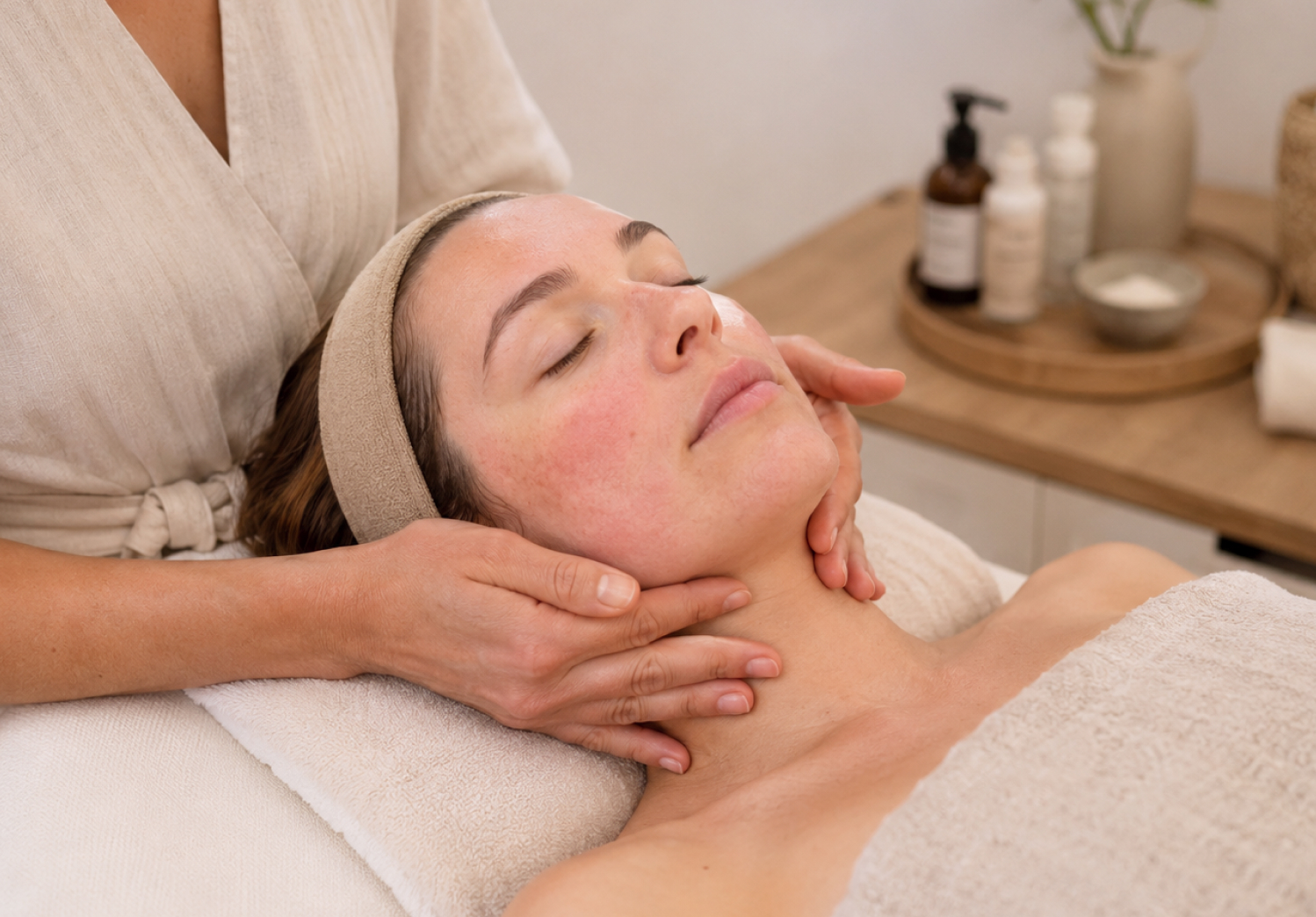
These three concerns show up in my treatment room more than almost anything else. Sometimes separately. More often, in combination — a client dealing with rosacea alongside sensitivity, or congestion layered on top of a reactive barrier. They overlap in ways that make skincare feel like a minefield, and they tend to make women cautious about any professional treatment that involves touching the face.
The caution is understandable. These conditions are real, they’re often unpredictable, and a wrong move can set the skin back for days. But avoiding professional care entirely leaves certain underlying issues unaddressed — issues that products alone struggle to reach.
This blog looks at each of these concerns honestly, explains what facial massage can and cannot do for them, and clarifies when treatment is appropriate and when it’s best to wait.
The caution is understandable. These conditions are real, they’re often unpredictable, and a wrong move can set the skin back for days. But avoiding professional care entirely leaves certain underlying issues unaddressed — issues that products alone struggle to reach.
This blog looks at each of these concerns honestly, explains what facial massage can and cannot do for them, and clarifies when treatment is appropriate and when it’s best to wait.
Rosacea
Rosacea is a chronic inflammatory skin condition. It’s not the same as general redness or occasional flushing, though it’s often confused with both. According to the National Rosacea Society, rosacea affects an estimated 16 million Americans and is characterized by persistent redness, visible blood vessels, and in some cases, small bumps or pustules, primarily on the cheeks, nose, forehead, and chin.
Rosacea has known triggers — heat, sun exposure, stress, certain foods, alcohol, and harsh skincare products are among the most common. The condition tends to cycle between flares and calmer periods. There is no cure, but symptoms can be managed with the right approach.
Rosacea has known triggers — heat, sun exposure, stress, certain foods, alcohol, and harsh skincare products are among the most common. The condition tends to cycle between flares and calmer periods. There is no cure, but symptoms can be managed with the right approach.
What facial massage can offer
During non-flare periods, gentle facial massage can support rosacea-prone skin in several ways. Lymphatic drainage helps reduce the fluid retention and swelling that often accompany rosacea, especially in the cheeks and mid-face. The calming effect of sustained touch on the nervous system can lower the stress-driven activation that triggers many flares. And improved circulation in the surrounding areas — the neck, shoulders, and scalp — supports overall tissue health without directly stimulating the most reactive zones.
Facial massage does not treat rosacea in a medical sense. It is not a replacement for dermatological care. But as a complement to medical management, it can help create conditions in the skin and body that support calmer, more stable skin over time.
Facial massage does not treat rosacea in a medical sense. It is not a replacement for dermatological care. But as a complement to medical management, it can help create conditions in the skin and body that support calmer, more stable skin over time.
When to wait
If rosacea is in an active flare — significant redness, visible pustules, swelling, or skin that feels hot to the touch — it’s generally best to wait until the flare settles before receiving facial massage. During a flare, the skin is in an inflammatory state, and even gentle stimulation can prolong or worsen it.
That doesn’t mean a session is off the table entirely during a flare period. Work can still be focused on the neck, shoulders, scalp, and upper body, which calms the nervous system and supports the body’s recovery without directly engaging the inflamed tissue. This approach is discussed before the session begins so the treatment plan matches what the skin can handle that day.
That doesn’t mean a session is off the table entirely during a flare period. Work can still be focused on the neck, shoulders, scalp, and upper body, which calms the nervous system and supports the body’s recovery without directly engaging the inflamed tissue. This approach is discussed before the session begins so the treatment plan matches what the skin can handle that day.
Congestion
Skin congestion — clogged pores, blackheads, a bumpy texture, skin that feels thick or dull — is one of the concerns that responds well to consistent facial massage, though not in the way most people expect.
Congestion is often the result of several things happening at once: excess sebum, dead skin cells that aren’t shedding efficiently, sluggish lymphatic flow, and sometimes inflammation underneath the surface that isn’t visible yet. Products can address the surface layer, but the deeper circulation and fluid stagnation that contribute to congestion sit below what a cleanser or exfoliant can reach.
Congestion is often the result of several things happening at once: excess sebum, dead skin cells that aren’t shedding efficiently, sluggish lymphatic flow, and sometimes inflammation underneath the surface that isn’t visible yet. Products can address the surface layer, but the deeper circulation and fluid stagnation that contribute to congestion sit below what a cleanser or exfoliant can reach.
What facial massage can offer
Regular sessions improve the circulation and lymphatic flow that influence how effectively the skin clears waste and turns over cells. When the lymphatic system is moving well, the tissue stays less congested between treatments. When circulation is strong, the skin’s natural shedding and renewal processes work more efficiently.
Facial massage also addresses the tension patterns that can restrict blood flow to congested areas. The jawline and chin — where congestion commonly concentrates in women dealing with hormonal buildup — are directly affected by how tight the surrounding muscles are and how well fluid moves through the lower face.
Over a series of consistent sessions, many clients with congestion-prone skin notice their texture becoming smoother, breakouts becoming less frequent, and the skin looking clearer between visits. These are cumulative results that build with regularity.
Facial massage also addresses the tension patterns that can restrict blood flow to congested areas. The jawline and chin — where congestion commonly concentrates in women dealing with hormonal buildup — are directly affected by how tight the surrounding muscles are and how well fluid moves through the lower face.
Over a series of consistent sessions, many clients with congestion-prone skin notice their texture becoming smoother, breakouts becoming less frequent, and the skin looking clearer between visits. These are cumulative results that build with regularity.
What facial massage does not do
Facial massage at Juventas Studio does not include extractions. Extractions are a separate procedure best performed by a licensed esthetician or dermatologist. Massage addresses the conditions that contribute to congestion — sluggish flow, poor circulation, tension — but it does not physically remove individual clogs from pores.
Sensitivity
Skin sensitivity is broad. It can mean a diagnosed condition like rosacea or eczema. It can mean a temporarily compromised barrier from overusing active products. It can mean a nervous system that’s been stuck in overdrive for so long that the skin has become hyper-reactive to things it once tolerated.
What these different forms of sensitivity share is this: the skin is in a state where its protective function has been weakened, and it responds to stimulation more intensely than it should.
What these different forms of sensitivity share is this: the skin is in a state where its protective function has been weakened, and it responds to stimulation more intensely than it should.
What facial massage can offer
When done with appropriate pacing, pressure, and product selection, facial massage can be deeply beneficial for sensitive skin. The nervous system calming that happens during a session — particularly one that begins with the chest, shoulders, neck, and scalp before approaching the face — directly addresses one of the core drivers of reactivity. When the body shifts from a stressed to a calmer state, the skin’s inflammatory threshold rises. Things that would have triggered a reaction an hour ago are tolerated more easily.
Over time, consistent sessions can help recalibrate how reactive the skin is. Clients with sensitivity often find that their skin becomes progressively calmer with regular care — not because the condition has been cured, but because the underlying nervous system and circulatory patterns are better regulated.
Product selection matters significantly for sensitive skin. At Juventas Studio, the products used during sessions — Green Envee, HydroPeptide, and Live Botanical — are chosen for their ingredient integrity and compatibility with reactive skin. Nothing with synthetic fragrance, high-percentage acids, or known irritants is applied during a sensitive-skin session.
Over time, consistent sessions can help recalibrate how reactive the skin is. Clients with sensitivity often find that their skin becomes progressively calmer with regular care — not because the condition has been cured, but because the underlying nervous system and circulatory patterns are better regulated.
Product selection matters significantly for sensitive skin. At Juventas Studio, the products used during sessions — Green Envee, HydroPeptide, and Live Botanical — are chosen for their ingredient integrity and compatibility with reactive skin. Nothing with synthetic fragrance, high-percentage acids, or known irritants is applied during a sensitive-skin session.
When to be cautious
Sensitivity that involves open wounds, active eczema flares, or skin that is currently peeling from a medical treatment is best allowed to heal before receiving facial massage. The skin needs to be intact enough to tolerate touch. A brief conversation before any session covers the current state of the skin and ensures the treatment plan is appropriate.
When These Conditions Overlap
In practice, rosacea, congestion, and sensitivity rarely appear in isolation. A client might have rosacea-prone skin that also gets congested along the jawline. Or a compromised barrier that’s reactive and simultaneously showing signs of blocked pores.
This is where customization becomes essential. A generic facial protocol — the same products, the same pressure, the same steps for every client — doesn’t serve skin that is navigating multiple concerns simultaneously. What serves it is a practitioner who can read the tissue, assess what’s happening that day, and adapt the session accordingly.
At Juventas Studio, every session is customized. The pressure, pacing, areas of focus, and products are all adjusted based on what the skin is presenting. If one area of the face is calm and another is reactive, the approach changes within the same session. If congestion is prominent one week and sensitivity is dominant the next, the treatment shifts to match.
That adaptability is what makes professional facial massage accessible to women with complex skin. It’s not about applying one approach and hoping for the best. It’s about responding to what’s actually there.
This is where customization becomes essential. A generic facial protocol — the same products, the same pressure, the same steps for every client — doesn’t serve skin that is navigating multiple concerns simultaneously. What serves it is a practitioner who can read the tissue, assess what’s happening that day, and adapt the session accordingly.
At Juventas Studio, every session is customized. The pressure, pacing, areas of focus, and products are all adjusted based on what the skin is presenting. If one area of the face is calm and another is reactive, the approach changes within the same session. If congestion is prominent one week and sensitivity is dominant the next, the treatment shifts to match.
That adaptability is what makes professional facial massage accessible to women with complex skin. It’s not about applying one approach and hoping for the best. It’s about responding to what’s actually there.
An Honest Perspective
Facial massage is not a medical treatment. It does not cure rosacea. It does not replace dermatological care for chronic skin conditions. And it is not appropriate for every skin state on every day.
What it can do — consistently and well — is support the systems underneath the skin that influence how these conditions behave. Circulation, lymphatic flow, muscle tension, nervous system regulation — these are all factors in how rosacea flares, how congestion accumulates, and how sensitized the skin becomes. When those systems are cared for regularly, the skin tends to behave better. Not perfectly. But better. And better, consistently, makes a meaningful difference in how a woman feels about her skin.
If you’re dealing with any of these concerns and wondering whether professional facial massage is safe for you, the answer for most people is yes — with the right practitioner, the right products, and the right conversation before the session begins.
Book Now
What it can do — consistently and well — is support the systems underneath the skin that influence how these conditions behave. Circulation, lymphatic flow, muscle tension, nervous system regulation — these are all factors in how rosacea flares, how congestion accumulates, and how sensitized the skin becomes. When those systems are cared for regularly, the skin tends to behave better. Not perfectly. But better. And better, consistently, makes a meaningful difference in how a woman feels about her skin.
If you’re dealing with any of these concerns and wondering whether professional facial massage is safe for you, the answer for most people is yes — with the right practitioner, the right products, and the right conversation before the session begins.
Book Now
FAQ Section
Should I tell my practitioner about my skin conditions before booking?
Yes. Sharing information about diagnosed conditions like rosacea, current medications, recent flares, or known product sensitivities before the session helps ensure the treatment is appropriate and safe. This conversation happens naturally during the consultation at the beginning of every visit.
Can facial massage make rosacea worse?
It can if done incorrectly — with too much heat, aggressive pressure, or irritating products. When done with appropriate care, avoiding known triggers and adapting the approach to the skin’s current state, facial massage typically supports calmer skin rather than provoking flares. During active flares, the treatment focuses on the neck, scalp, and shoulders while giving the face lighter or no direct work.
Will facial massage clear my congestion?
It supports the conditions that help the skin clear itself — improved circulation, better lymphatic flow, reduced tension in the areas where congestion tends to concentrate. Over a series of sessions, many clients notice smoother texture and fewer breakouts. However, facial massage does not include extractions. For persistent congestion requiring manual extraction, a dermatologist or licensed esthetician is the appropriate resource.
My skin is sensitive because I damaged my barrier with products. Can I still come in?
In most cases, yes. A compromised barrier benefits from gentle, supportive care. Sessions focus on calming the nervous system, restoring circulation, and using products that support barrier repair rather than further challenging it. If the barrier is severely damaged or the skin has open areas, waiting for initial healing may be recommended.
How often should I come if I have rosacea or sensitive skin?
Starting with sessions every two weeks is a common approach for reactive skin. This allows the skin to respond and recover between appointments. Once the skin stabilizes and the nervous system begins to regulate more consistently, the frequency can be adjusted based on how the skin is behaving. Some clients find biweekly sessions ideal. Others move to monthly maintenance.